






Heritage
The Saint-Louis Story
Few houses can trace their fire back more than four centuries. The story of Saint-Louis begins in a narrow valley of the northern Vosges, where glassmakers were already at work long before crystal existed in France, and it continues today in the same village, where each glass still passes from breath to wheel to the hands of an inspector before it is signed.
From Münzthal to Royal Crystal
The first glassworks in the valley of Münzthal is recorded in 1586. War brought it to a halt in the seventeenth century, when the Thirty Years' War devastated the region, and the valley fell quiet for generations. Its revival came in 1767, when the works became the Verrerie Royale de Saint-Louis and took the name that the village, Saint-Louis-lès-Bitche, carries to this day.
The decisive moment came in 1781, when Saint-Louis craftsmen solved the formula for crystal, more than a century after the English glassmaker George Ravenscroft first developed the process. In 1829 the manufactory was renamed the Cristallerie Royale de Saint-Louis and turned entirely to crystal. That same period produced the Trianon service, which introduced the idea of a matching set of table glasses.
Chandeliers followed in 1837 and paperweights in 1845, and Saint-Louis paperweights are still made today. In the early twentieth century, Art Nouveau and Art Deco shaped the house's designs, with artists such as Paul Nicolas, Jean Sala, Jean Luce, Michel Colle and Maurice Dufrêne working alongside the glassmakers. Since joining Hermès in 1995, Saint-Louis has invited designers including Hervé van der Straeten, Paola Navone, Kiki van Eijk and Ionna Vautrin to create for the table, for decoration and for lighting.
Fire, Breath and the Cutting Wheel
The work begins in the hot workshop. Crystal is melted at 1,450 °C (about 2,640 °F), purified, and gathered on the blowpipe, then shaped by mouth and pressed in a mold to form the first gather, called the paraison. The glassmaker's control of heat, timing and breath decides the final form.
In the cold workshop, cutters take over. Their vocabulary runs from simple flat cuts to the house's emblematic diamond cut, with facets described as pearls, olives, almonds and bevels. A single engraved and gilded glass can require 30 to 35 separate operations. Gilding is done in 24-carat gold applied by brush and by hand only, after which the piece is fired again at 500 °C (about 930 °F) to set the decoration.
Throughout, inspectors known as choisisseuses examine every piece, and only those they approve are signed and placed in the house's signature Saint-Louis blue box. Several of the manufactory's master glassmakers and cutters hold the title of Meilleur Ouvrier de France. The same hands produce monumental commissions too: one of the largest chandeliers in the world, with 3,000 crystal parts, took two months to complete.
Patterns for the Table and the Bar
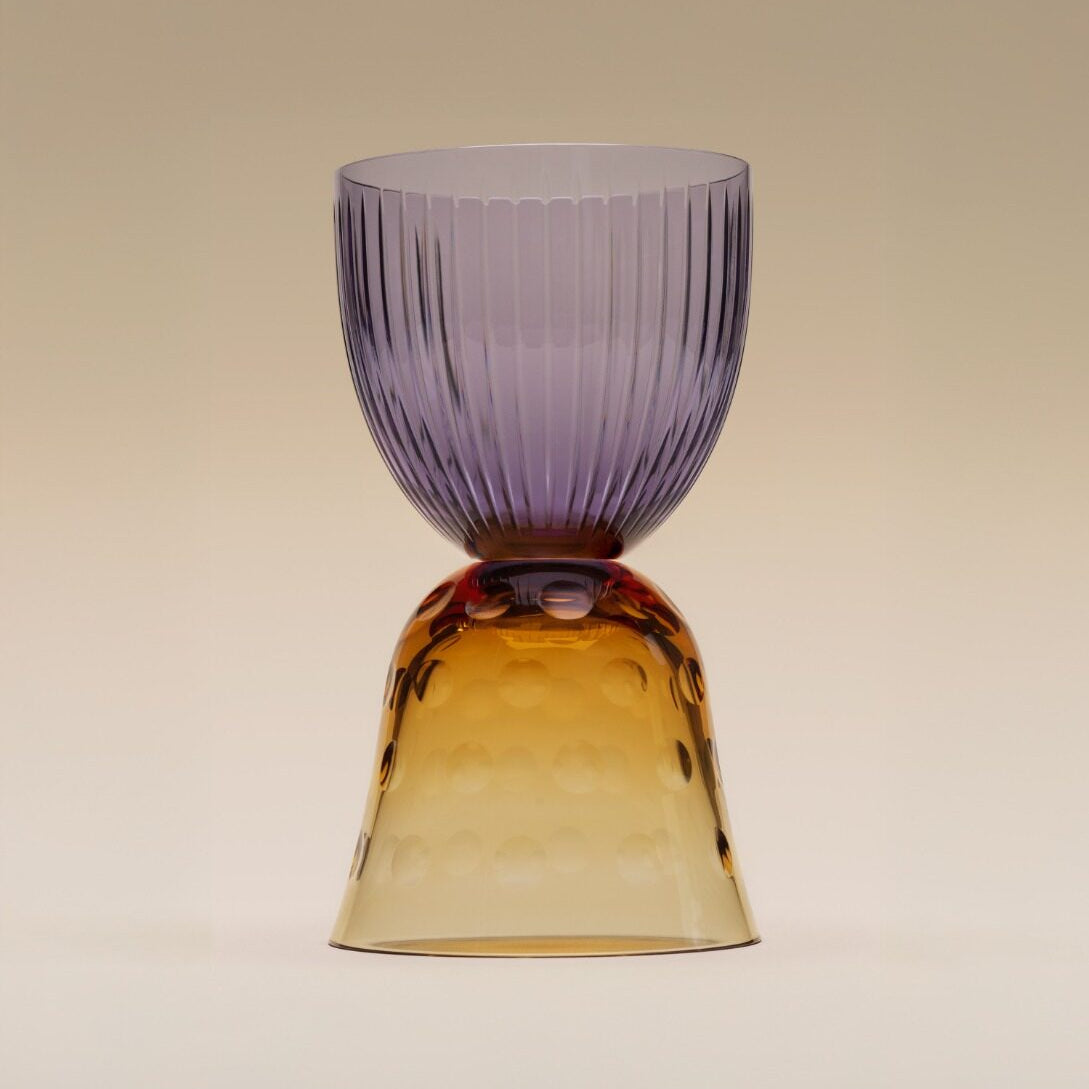
Tommy has graced tables since 1928, and its details reward a close look. Each stem rises from a star-shaped base, and the bowl is cut with diamond, bevel, fillet and pearl facets that throw light across the table. Beyond clear crystal, it comes in colors such as flannel gray, amethyst, chartreuse and light blue, which makes it easy to build a table glass by glass.
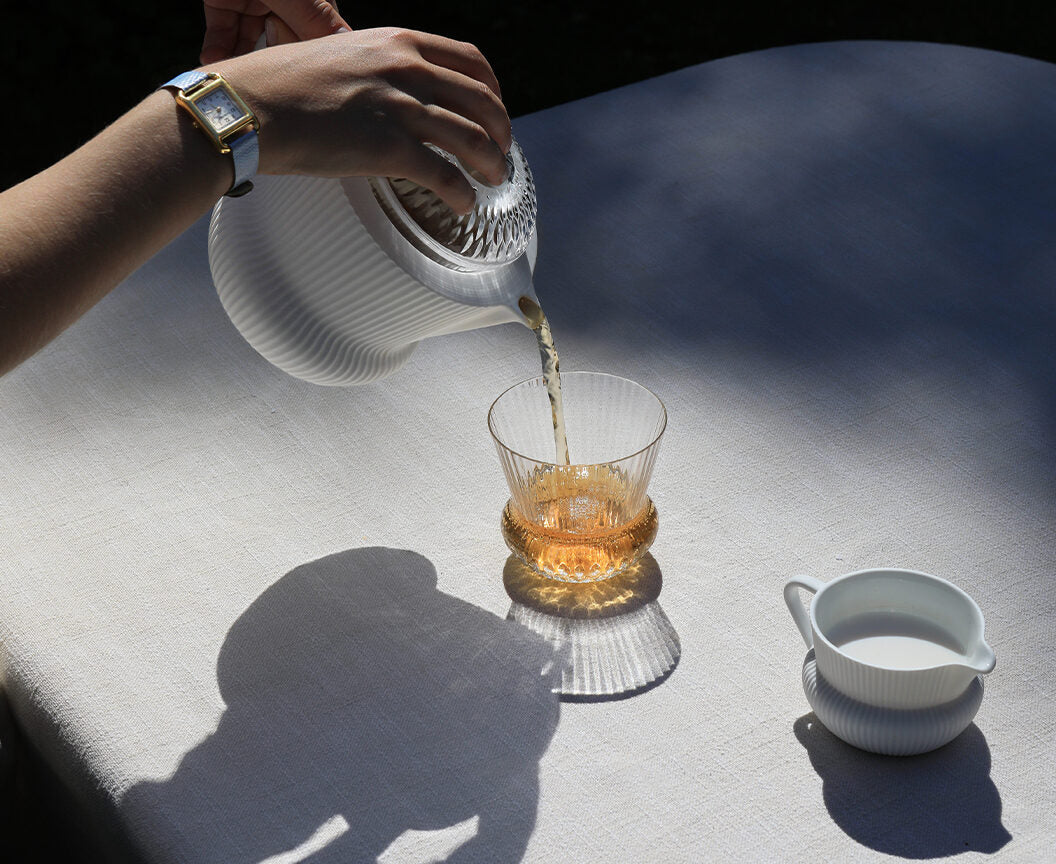
Twist 1586 takes a different approach. Rather than a classic stemware suite, it is a family of tasting glasses for aged wines, fortified wines, champagne and spirits, each gather decorated with Venetian-style ribs that catch the light and highlight the color of what is poured. A spirits decanter and table tumblers complete the set.
For a more architectural look, Oxymore was designed by the manufactory's own master glassmakers and cutters, while Bubbles, created by Teleri Ann Jones, has been made since 1992. Apollo offers clear cut crystal for the table and bar, including pieces finished with a fine gold filet, and the Caton decanter brings a classic cut silhouette to the bar cart. Collectors who favor serving pieces will find more among the house's decanters.
The Royal pieces carry history of their own. The first Royal chandeliers were made at Saint-Louis in the mid-nineteenth century as special orders for royal courts, and the house reinterpreted them as the Royal collection in 2015, with sizes, decoration and colors that can be combined in more than 50,000 ways for a single chandelier. Saint-Louis lamps bring the same crystal light to a side table or console.
Living with Saint-Louis Crystal
Saint-Louis is meant to be used. A pair of Tommy wine glasses or Twist 1586 tasting glasses is a natural first step, and because colors and shapes are sold individually, a service can grow over years, one occasion at a time. Mixing clear and colored crystal on the same table is part of the house's spirit.
To care for hand-cut and gilded crystal, wash each piece by hand in warm water with a mild soap and a soft sponge, and dry it with a soft cloth while still warm. Store glasses upright, not on their rims, and give gilded edges extra attention so that the gold stays bright for generations.
Saint-Louis craftsmen first made crystal in 1781, and the house turned entirely to crystal in 1829. See our Saint-Louis crystal vases and Saint-Louis wine glasses.
Questions about Saint-Louis, a pattern or a missing piece? We are happy to help:
info@paristableware.com · (201) 652-4233