


Heritage
The Daum Story
The Daum story begins with a change of course. Jean Daum was a notary in Bitche, in Lorraine, who chose to remain French after the war of 1870 and moved to Nancy in 1876. Two years later he invested in the struggling Sainte-Catherine glassworks there, a business making everyday glass, and brought his son Auguste in beside him. What followed turned a practical factory into one of the great names in French decorative art.
From Window Glass to Art Glass
After Jean's death in 1885, Auguste took the helm, and his younger brother Antonin, an engineer trained at the École Centrale, joined him in 1887. Antonin created the factory's first art department, and its earliest vases, carved with finely chiseled, colorful flowers, already pointed toward the Art Nouveau style. In 1900 the brothers received the Grand Prize at the Paris World's Fair.
Nancy was then a hotbed of new ideas, and the Daum brothers stood at its center. When the École de Nancy was formally organized in 1901, Émile Gallé became its president and Antonin Daum its vice-president. In 1904 the glass artist Amalric Walter arrived and introduced pâte de verre to the house, and in 1910 the brothers created their first "mushroom" lamp, giving light itself a sculpted glass form.
A Century of New Directions
Each generation brought its own vision. In the 1920s Paul Daum, Jean's grandson, led the house toward Art Deco, with straight geometric lines and a wider range of colors. Crystal entered production in the 1930s, the decade in which Daum supplied tableware for the French ocean liner Normandie, and in the years that followed crystal replaced glass entirely, opening the way to fluid, sculptural shapes.
The late 1960s brought the turning point that defines Daum today. The house revived pâte de verre, adopted lost-wax casting, and invited leading artists into its workshops: designer Roger Tallon in 1967, Salvador Dalí in 1968 and the sculptor César in 1969. Dalí's collaboration produced a series of 23 works in which crystal paste became a supple medium for his surreal visions of time and desire.
Later partners included Hilton McConnico in 1986 and Arman in 1997, and in 2007 Daum was named an Entreprise du Patrimoine Vivant, the French state's label for companies with rare artisanal know-how. In all, more than 350 artists and designers have created for the manufactory.
How a Daum Piece Is Made
Every sculpture starts as a sketch, which a sculptor models by hand in clay. That original is used to make a flexible elastomer mold, into which hot wax is poured; the wax copy is then refined until it matches the sculpture exactly. The wax model is encased in refractory plaster and heated until the wax melts and runs out, which is why the method is called lost-wax casting. The plaster shell left behind becomes a one-time mold for that single piece.
Fragments of colored crystal, known as groisils, are set in pots above the mold and melt down into it in the kiln, where a single piece may need as long as 21 days of firing. Once cooled, the plaster is broken away by hand, and artisans in the cold workshop polish and finish the crystal before it is checked and signed. The house works with a palette of 40 shades, and because the mold is destroyed each time, the whole process is repeated for every copy.
Signature Collections
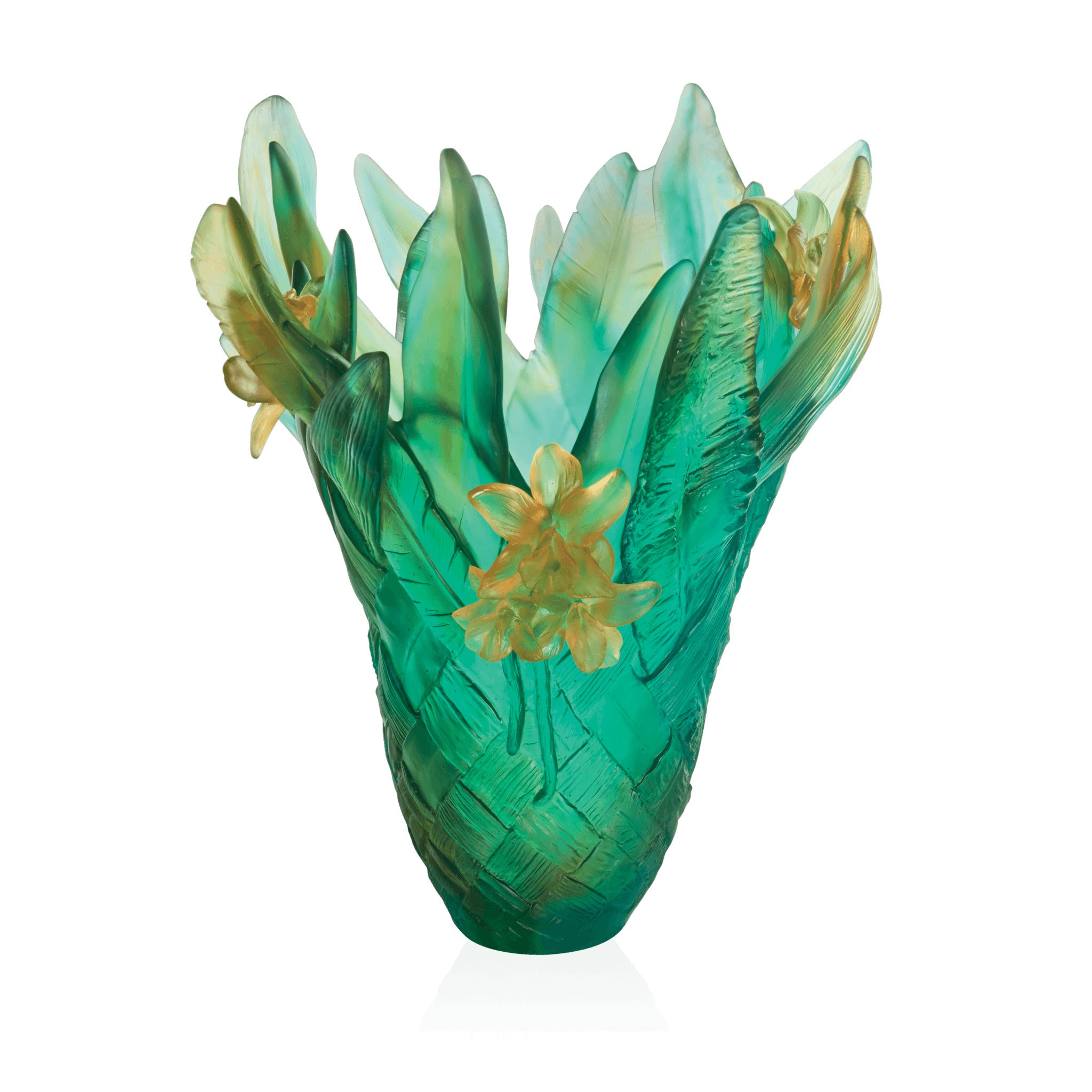
Nature has always been Daum's favorite subject. The rose is reinterpreted by the house again and again, and Rose Passion, introduced in 2012, gathers botanical sculptures, vases and bowls in soft, dreamlike hues. Ginkgo, launched in 2003, turns the tree's fan-shaped, veined leaf into crystal, while the floral artist Emilio Robba brings a contemporary eye to plant forms in pieces such as the Jardin de Cactus line, offered in deep greens with mineral blues or in pale whites and soft gray, and a Monstera leaf wall lamp; see the full Emilio Robba selection.
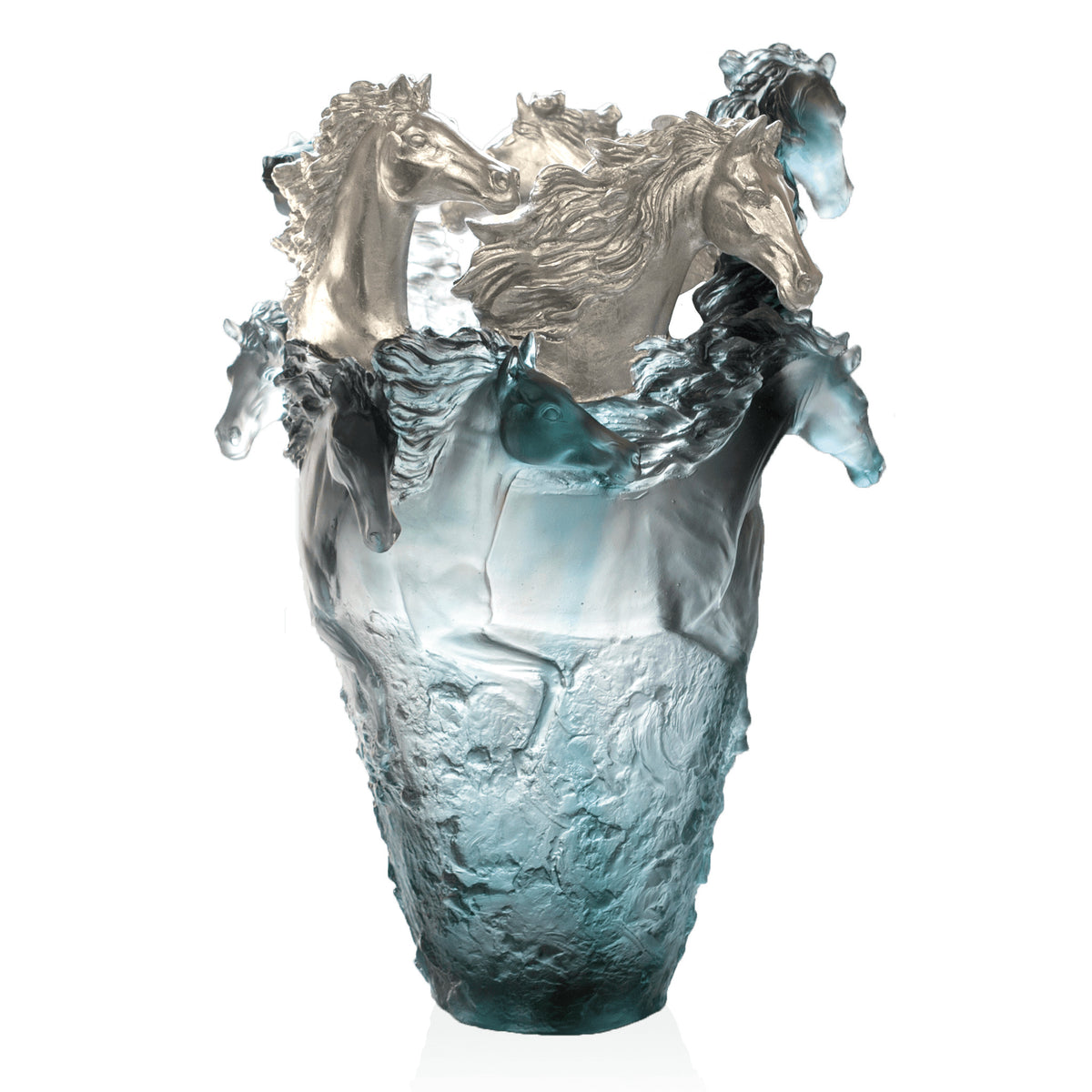
Animals are the other great theme. Since 2014, Cavalcade has celebrated the horse in motion, its colors ranging from deep amber to bluish gray with golden reflections. The French artist Richard Orlinski brings his "Born Wild" concept to a series of bold Orlinski sculptures, among them the gorilla Wild Kong and the Wild Panther.
Living with Daum Crystal
A Daum piece rewards a place where light can move through it: a console near a window, a mantel, or the center of a dining table where a vase or bowl catches candlelight at dinner. Several pieces in a single collection grouped together make a striking display, and a sculpture marking a wedding, an anniversary or a new home tends to become a family heirloom.
Care is simple but should be gentle. Daum recommends dusting crystal paste with a soft, dry microfiber cloth, without water or cleaning products, and treating gilded details with only a very soft brush. Keep pieces out of direct sunlight and away from strong heat sources to avoid thermal shock, set them on a stable surface that can bear their weight, and handle them with care, avoiding slippery cotton gloves, since every piece is fragile as well as unique.
Choosing Daum crystal often starts with the kind of piece: browse Daum crystal vases, sculptures and bowls, or start from a theme or designer on Daum collections. Limited editions are numbered, and the edition size is part of the name: a sculpture marked 375ex, for example, is made in an edition of 375. Because every piece is made and finished by hand, color and shading vary slightly from one piece to the next, which is part of what makes Daum crystal from France so collectible.
Questions about Daum, a pattern or a missing piece? We are happy to help:
info@paristableware.com · (201) 652-4233